Sunday, April 15, 2007

My Winter Travels, Part 15: Xi'an
Xi'an Picasa Photo Album
After we spent Spring Festival in Beijing, we took a sleeper train to Xi'an in Shaanxi province. Sleeper trains in China are great--it saves you the cost of staying at a hotel, and you wake up in the morning at your location. If you ever travel in China, I highly recommend you travel by sleeper train. Xi'an has one of the longest and most impressive histories of any city in the world--it has been the capital of 13 Chinese Dynasties, beginning from before the birth of Christ. Yet for some reason, it's not a well-known city in the west (I had never heard of it before coming to China). Overall, I'd say Xi'an might have been my favorite place we visited on the trip--primarily because of the Army of Terracotta Warriors, one of the most amazing things I've ever seen. We spent 3 full days in Xi'an, before we took a sleeper train back to Beijing on February 22nd.

Xi'an City Walls

On our first day in Xi'an, we visited the ancient city walls of Xi'an. The current city walls were built in the 14th century. Much of the city of Xi'an is outside the walls today, but most of the historical buildings and interesting sights are within the city walls. Some pictures:


The city walls had some decorations along the southern portion of it. I think it was just there for Spring Festival.


The southeast corner of the city walls.


We rented bicycles and biked the entire 8.7 miles around the city walls.


There were various battlements and guard towers at regular intervals.


I think this was some kind of ancient catapult.


The city walls stretch for as far as the eye can see...

We rounded out our first day in Xi'an by doing some souvenir shopping and walking through the Muslim quarter (Xi'an is home to a very large Muslim population).

The Army of Terracotta Warriors

On our second day in Xi'an, we visited the Army of Terracotta Warriors, our main reason for visiting Xi'an. In the 3rd century B.C., Qin Shi Huang unified China and became China's first emperor. He began many construction projects (including the initial version of the Great Wall of China), one of which was a grand mausoleum where he was buried. Being a mad tyrant, he had his laborers build him a grand army to guard his tomb. More than 6,000 unique, individual statues were built and buried. The army lay unknown for over 2,000 years before being discovered by a farmer in 1974. It's turned out to be perhaps the greatest archaeological find of the 20th century (the Dead Sea Scrolls would also rank up there).

Pictures don't do the terracotta warriors justice. There are some things in the world that look just as good (or maybe even better) in a photograph than in person. The terracotta warriors are not one of them--seeing it in person is breath taking. Some pictures:


Pit #1. There are about 10 rows of these statues.


Different statues were different kinds of warriors. This one was an archer. They've taken all the bronze weapons and put them in a vault for now.


Lots of the warriors were headless. This is from pit #3 were the warriors were arranged like they are officers in the military command center.


Each warrior has a unique face.


They also found a bronze chariot with 4 horses.

China likes to toot its own horn, and it was no exception here. They say they have no record of the warriors (and hence were completely unknown until the farmer found them), and yet somehow they know it took 700,000 workers 38 years to construct it. Where does a number like that come from? They also make some pretty extravagant claims about the nearby tomb of Emperor Qin, where there are supposedly tons of gold and buried treasure beneath the giant mound. But they haven't opened it up because they say we don't yet have the technology to properly excavate it and keep all the artifacts from corroding. I think its just as likely that there's nothing impressive there--either because there never was or because grave robbers have taken all of it.

Shaanxi History Museum

On our last day in Xi'an, we visited the Shaanxi History Musuem. The museum has artifacts from all of China's known history. Here are a couple of the more interesting items:


We also saw several other things in Xi'an that I would not recommend. If you ever visit Xi'an, make sure you see the above three things, but don't bother with the Tomb of Qin Shihuang, Banpo Neolithic Village or the Huaqing Pool.

After our three days in Xi'an, we took a sleeper train back to Beijing, where we wrapped up the trip with a visit to the Great Wall and Beijing's Hutongs.

Saturday, April 14, 2007

My Winter Travels, Part 14: Beijing

Beijing Picasa Photo Album
After visiting the gorgeous mountains of Huang Shan, we took a bus back to Hangzhou to catch a flight to Beijing on February 16th. Originally we were planning to go to Xi'an next, but I think it turned out better being in Beijing during Spring Festival. My friend Liu Kai--who I traveled with during the first two weeks of the trip (to Hainan, Guilin and Yangshou)--is from Beijing and was home during Spring Festival, so he was able to hang out with us and show us around Beijing a bit. We spent 3 days in Beijing before taking a train to Xi'an, after which we came back to Beijing for another day (I'll talk about that last day in a separate post). We did a lot during those 3 days in Beijing--we visited Tiananmen Square, the Forbidden City, the Temple of Heaven, the Summer Palace, went shopping at the Pearl Market, saw lots of fireworks, went to a Spring Festival street carnival and saw an acrobat show. Our hotel (which Liu Kai booked for us) was at a great location--most of this stuff was within walking distance.

Tiananmen Square & the Forbidden City

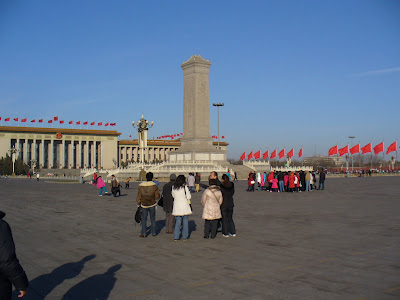
Tiananmen Square is the largest public square in the world (Wikipedia lists it as 440,000 square meters!). Unfortunately, it's so big that there's no way to adequately capture it on film. But here's my attempt:


The Monument to the People's Heroes at Tiananmen Square.

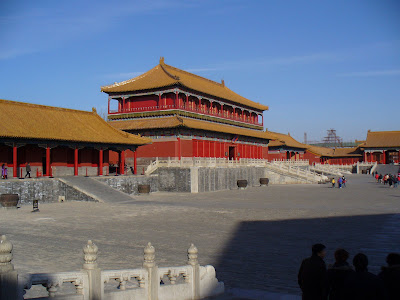
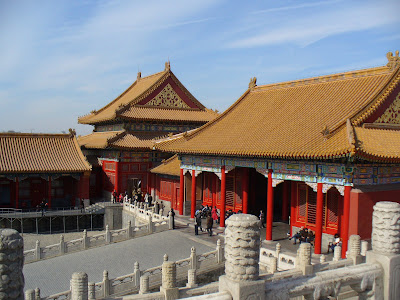
We visited Tiananmen Square first thing on our first morning in Beijing. The Forbidden City is next to it, so we visited that on the same day. The Forbidden City was the imperial palace for about 500 years. It was forbidden for the public to enter it (hence the name). Calling it a city might be a bit of a stretch, but it is enormous--my guide book says it has 9,999.5 rooms (I don't know how you have half a room, but it's supposed to be just less than 10,000 to show the emperor's inferiority to the gods). It's one of the highlights of Beijing. However, I didn't enjoy it as many of the other things we saw in Beijing and elsewhere on the trip. Part of that might be because some of the main buildings were undergoing renovation to be ready for the 2008 Olympic games. Here are the pictures:


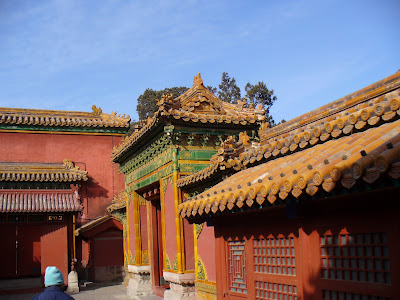
The Forbidden City.


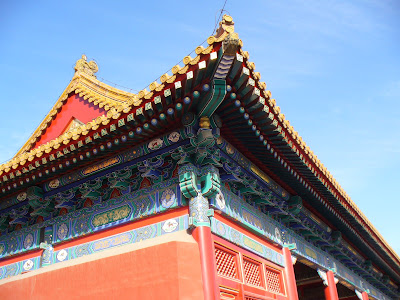
Check out the painting on the underside of the roof.


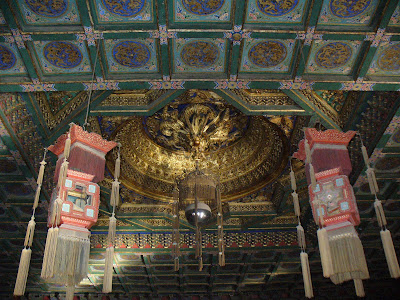
The interior of one of the 9,999.5 rooms.


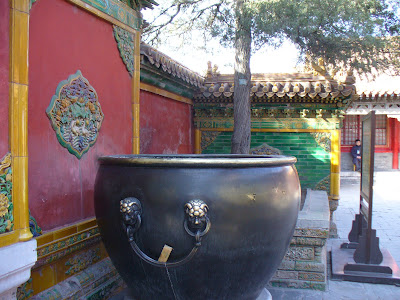
You could feed a lot of people using this pot!


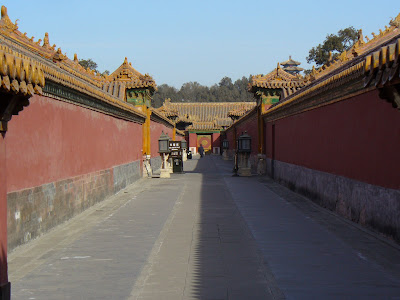
The Forbidden City had several of these alleys.


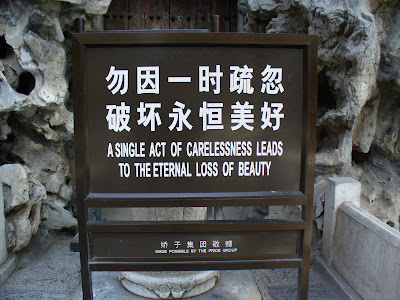
Chinglish strikes again. Although maybe it explains why I'm not very beautiful :).


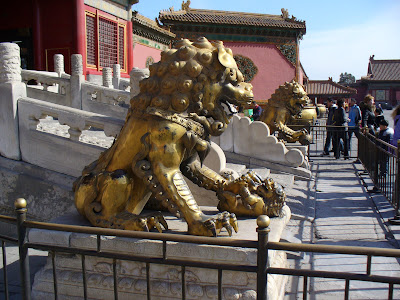
These lion-like creatures are found all over China.


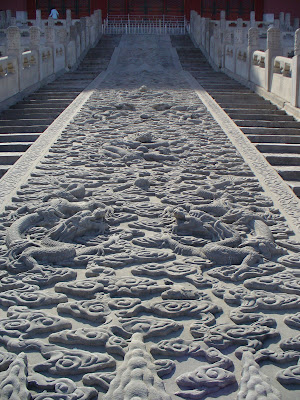
Quite the carving, isn't it?


Spring Festival

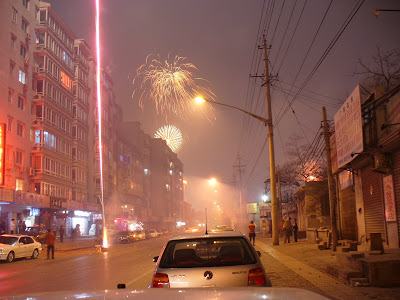
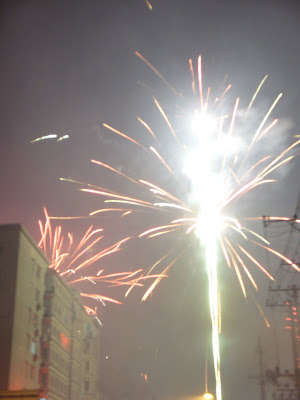
Spring Festival (also called Chinese New Year) was February 18th--our second full day in Beijing. It was cool to see how this was celebrated (at least how it's celebrated in Beijing). On Spring Festival eve, they set off tons of fireworks, especially right at midnight. You may think Americans go crazy with the fireworks on the 4th of July, but that's nothing compared to the Chinese on Spring Festival eve (the Chinese invented fireworks, after all). It was a bit scary, to be honest--there are millions of people on the streets all setting of their own fireworks in every which direction. Looking down one street, you could see 30-40 separate groups setting off their own fireworks, oblivious to the others around them. I'm surprised they don't have many injuries or burned buildings on Spring Festival, but apparently that's a rarity (at least rarer than on the 4th of July in the states). I was planning to walk towards Tiananmen Square to view the fireworks from there, but there were so many fireworks going off on the streets that I didn't feel like I could safely navigate them. So I just enjoyed the fireworks from where I already was. Here are some pictures:


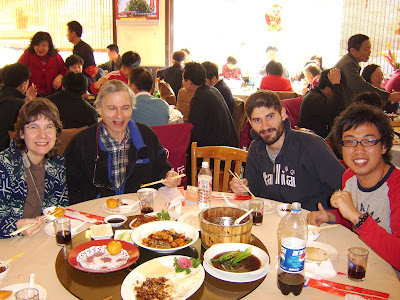
The next day (Chinese New Year's day) we met up with Liu Kai and got a great meal at a restaurant of Beijing Duck, one of my favorite Chinese dishes. You put the roasted duck, cucumbers, onions and a fermented bean sauce on a wheat pancake, roll it up, and eat it. Very tasty.


My parents, Liu Kai and I. You can't see it very well, but the Beijing Duck is on the white tray that has a handle shaped like a duck's head.

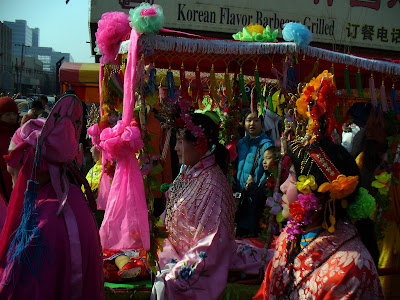
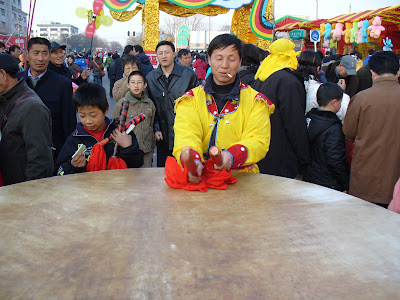
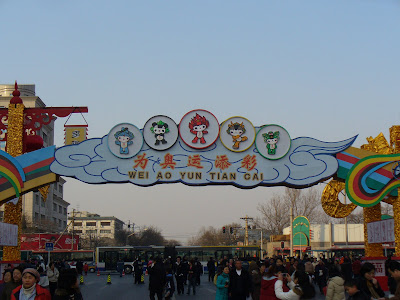
Then we went to a street carnival. There were lots of street vendors here. We also found a Chinese musical instrument store, so I bought an Erhu. Some pictures:


The Five Friendlies--Beijing's Olympic mascot. From left to right, they are named Beibei, Jingjing, Huanhuan, Yingying and Nini. If you take out the duplication, together they spell "Beijing Huangying Ni", which means "Beijing Welcomes You".

The Temple of Heaven

The Temple of Heaven is another of Beijing's highlights. It's a park with several ancient buildings. The emperor would come here annually to pray to the gods for a good harvest. We visited it the morning of Chinese New Year's day, before meeting up with Liu Kai. I liked it better than the Forbidden City.

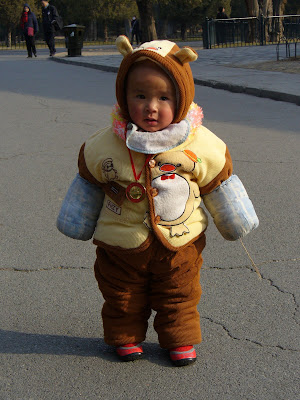
We met this kid at the Temple of Heaven. I think he'd win any cuteness contest he entered.


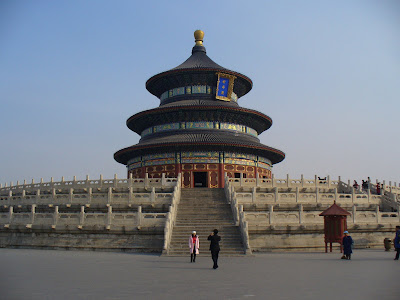
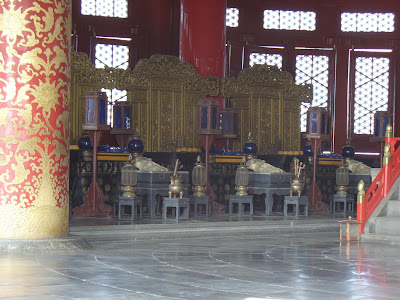
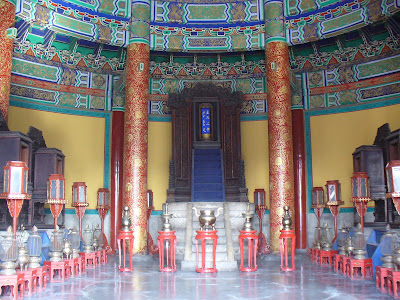
The Hall of Prayers for Good Harvest.


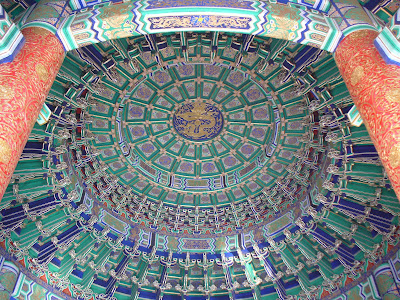
The interior of the Hall of Prayers for Good Harvest.


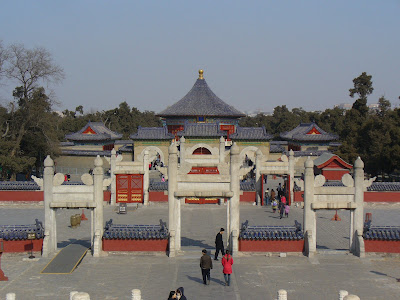
The park grounds.

Chinese Acrobat Show

After visiting the Temple of Heaven and hanging out with Liu Kai, we ended our Chinese New Year's day by taking in a show of Beijing Acrobats. The acrobats were amazing--they did things I didn't know anyone could do. These videos should give you a taste for what they did:


The Summer Palace

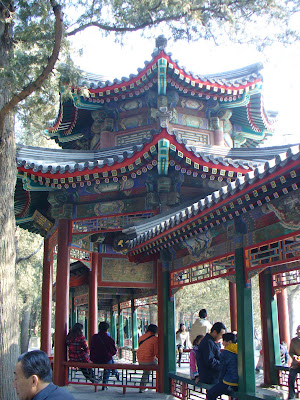
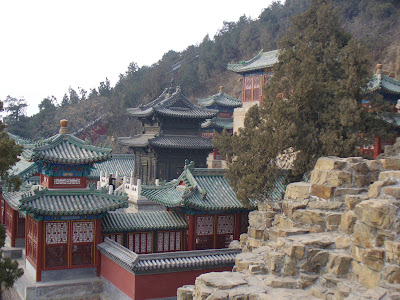
The Summer Palace is another of Beijing's major sights. It doesn't have as much history as the Temple of Heaven or Forbidden City, but it was still quite spectacular. We visited it on February 19th, the day after Chinese New Year. Some pictures:


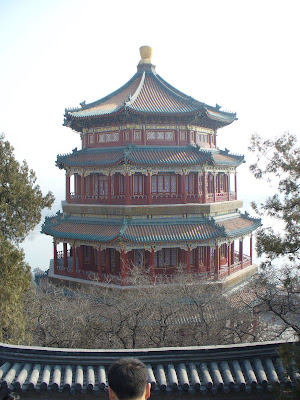
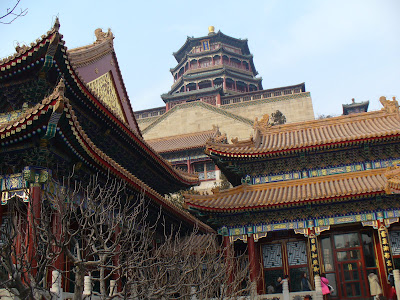
The Tower of Fragrant Buddha.


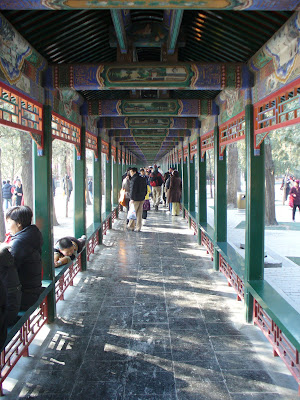
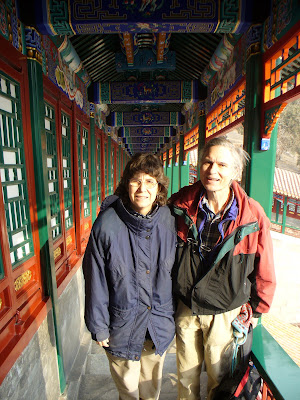
The Long Corridor. It's almost 1 Km long and is covered in paintings--Wikipedia says there are more than 14,000 of them.


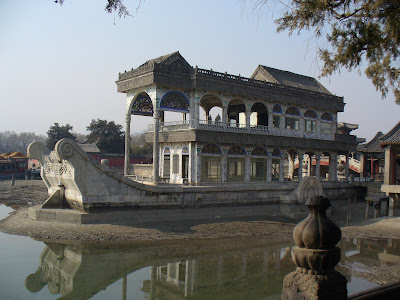
The Marble Boat.


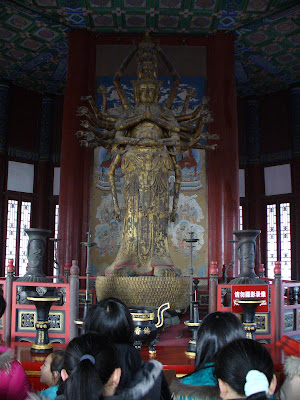
This is called the Thousand-Handed Buddha, even though it doesn't have nearly a thousand hands.


Another view of the Tower of Fragrant Buddha.


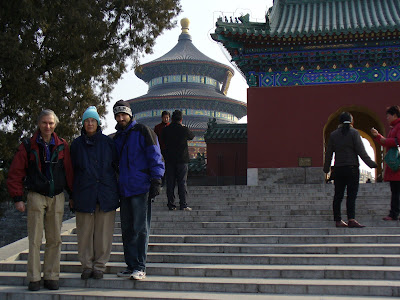
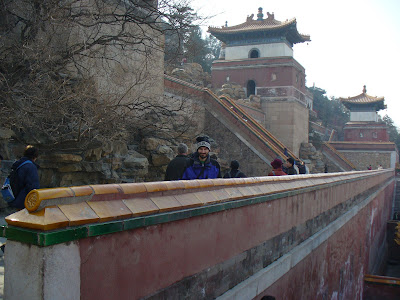
My parents on the stairs up to the Tower of Fragrant Buddha.

After we visited the Summer Palace, we took a night train to Xi'an, where we spent 3 days.