Drew and I spent a total of five days in Tibet. We spent most of our time in Lhasa. We also took a two-day excursion to Shigatse, the second biggest city in Tibet. Many Han Chinese (the dominant ethnicity in China--over 90% of the Chinese are Han) have moved to Lhasa, creating separate Han and Tibetan sections of town. In contrast, the residents of Shigatse are almost all Tibetan, which was the main reason Drew and I chose to visit. We were also hoping to continue on to see Mt. Everest, but that didn't work out :(. It's a shame that we made it to Tibet and didn't get to see the tallest mountain in the world, but we were short on time since we had bought a train ticket to leave Lhasa the morning of the 6th. Tibetan new year was coming, and we were told there would be less transportation availability in the next few days as a result. If we had chosen to continue on to a point near enough to Everest to see the mountain, we essentially would have spent the rest of our time in Tibetan just getting rides.
The Tibetans don't seem to have any problems selling corpses or heads on the street, as we saw this in several places. I think these are lamb corpses and lamb heads.
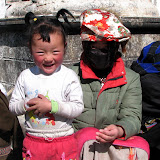
A few Tibetans we met in the Shigatse main square.
The Tashilhunpo Monastery, built in 1447.
The view of Shigatse from the monastery.
This is what remains of the once imposing Shigatse fortress.
I'm not sure what purpose this little fake mountain serves, but it makes an interesting picture :).
Some Tibetans we met in the van we took back to Lhasa.
After spending two days in Shigatse, we returned back to Lhasa to catch our train on to Lanzhou on February 6th.
After spending a few days in Chengdu, Drew and I flew to Lhasa, Tibet on the morning of February 1st. In retrospect, flying to Tibet probably wasn't the best idea, since you are supposed to gradually adjust to the altitude rather than jumping in with both feet, so to speak. But given what else we wanted to do on this trip and when spring semester began, we were short on time, so we flew.
In case you didn't know, Tibet is on a high plateau, most of which is over 12,000 feet. The air at 12,000 feet is very different from how it is at sea level. It has much less oxygen. To make matters worse, I've had this weird problem my whole life: every time I've ever had blood taken, for a blood test or whatever, I always begin to black out, hear a strange ringing in my ears and just feel generally awful--unless I'm lying down while the blood is taken. And that's exactly what the Tibetan air did to me. After our plane landed, I stood up, and I could feel a black out coming on, so I promptly sat down and let everyone else get off the plane. But I couldn't stay sitting forever, so I stood up, walked down the stairs and promptly collapsed on the tarmac. These Chinese dudes came to my aid and helped stand me up and get me on my way...and then I collapsed again. My head hit the concrete this time and blood was rushing everywhere. (Just kidding about that last sentence...but wouldn't that make a better story?) Again, the Chinese guys stood me up, and walked with me into the airport. Once I got inside, I was okay. Drew later told me that I looked blue at the time. The Tibetan air really does make a difference. When we got to our hostel, we had to walk up four flights of stairs to our room, and it was seriously about as exhausting as the 1,200 stairs we had climbed at Wat Tham Suea in Krabi. We spent our whole first day just sleeping. Given the physical strain Tibet puts on you, it's not really a place you enjoy visiting. Nevertheless, I'm very glad I got to visit Tibet. It's a special place very few people ever get to see.
Drew and I spent a total of four days in Tibet--two days in Lhasa, followed by two days in Shigatse (which I'll talk about in my next post), followed by two more days in Lhasa.
Lhasa is by far the least-polluted Chinese city I've visited. You can see so much farther than you can in the haze of Beijing or Shanghai. And everywhere you look, you are surrounded by mountains.
Potala Palace, the old seat of the Tibetan government and the winter residence of the Dalai Lamas. It was built in the 17th century. Unfortunately, we weren't allowed to take photos inside, so all you get to see is the outside.
All over Tibet there are these rotating cylinders. I'm not sure what it means, but the Tibetans spin them as they walk by.
The Jokhang Temple in the Barkhor circuit. Tibetan pilgrims walk this circuit and fall face down every few feet, prostrating themselves as an act of worship.
Tibetan children.
After returning to Lhasa from Shigatse, we went to the nearby Drepung Monastery, what was once one of the largest monasteries in the world. Before Chinese soldiers marched into Lhasa in 1959, there were about 7,000 monks here.
A sun-heated kettle at Drepung Monastery.
Sheep at the monastery.
This gives you an idea of what Tibetan writing looks like. It's entirely different from any other script I have seen.
Inside the monastery.
Tons of fireworks were set off our last night in Lhasa. Tibetan and Chinese new year don't always coincide, but they were on the same day this year. However, our last night in Lhasa was two days before the new year, so we were surprised to see so many fireworks.
I'll be getting back to my winter travels shortly, but I wanted to take a moment to talk about information access and propaganda in China. Most everyone knows that China doesn't have the same freedom of the press and freedom of the speech guaranteed in the Bill of Rights. But how bad is it really?
I found a news story today that I think illustrates the truth really well, so I wanted to share it with you:
Don't Be Too CNN, don't turn black into white
The wave of anger and patriotism generated by CNN's recent offensive coverage of China has produced a smash hit song and stirred millions of Internet users into an online show of solidarity.
Don't Be Too CNN, a track that lampoons the network for its coverage and analysis of the Tibetan riots, is written and performed by an online singer who calls herself "Murong Xuan".
It is backed by a music video contrasting CNN footage and what is really taking place in Tibet, and the lyrics attack distorted and biased coverage of the recent riots in Lhasa.
"Why do you rack your brains in trying to turn black into white? Don't be too CNN," Murong croons.
"CNN solemnly swears that everything on it is the truth, but I've gradually discovered this is actually a deception."
As the song continues, images of burnt-out shops and smoke rising over Lhasa flash across the screen repeatedly.
"Don't think that repeating something over and over again (means that) lies become truth," the lyrics run.
The song had been played 160,000 times by 7 pm yesterday on video.sina.com.cn. Other portal websites have also used it.
One netizen left a message on the website requesting Murong to sing the song in English for "all peace-lovers around the world".
...
CNN's credibility has taken a dive in China ever since the network cropped photos of a mob attacking military vehicles from a photograph in order to portray an overbearing military presence in Lhasa.
...
Meanwhile, millions of Chinese netizens put off by the bias in Western media coverage of the Tibetan riots have festooned their MSN messenger names with hearts and "CHINA".
Today, the Chinese have more access to information than at any point in their history. Using the internet, the Chinese (at least the ones who can speak English) can access tons of websites reporting news that's untouched by Chinese government censorship. Most major Western news sources are available in China, with a few high profile exceptions--until this month, BBC and Wikipedia have always been blocked during my time in China. (I've heard rumors that they have been unblocked to provide the illusion of free access to information when all the Olympic journalists arrive). But it doesn't really matter--the Chinese people keep being deceived. Chairman Mao is still the greatest man who ever lived, according to all of my students (never mind that his policies starved 20+ million people, or that his leadership was an unqualified disaster even without considering any of the moral issues). Taiwan is part of China and always has been. China has complete freedom of religion for all it's people. The Dalai Lama is a terrorist.
Sometimes it's shocking at how completely the government's propaganda has triumphed over the minds of the people, but you begin to understand when you realize how great the government is at producing effective propaganda. For example, take the news story I posted above. The story doesn't really even address the claims that CNN has made about the Tibet situation, because it doesn't have to. Instead, the story just confirms in the mind of the Chinese people how biased all those Western news sources are. They've even created a song to show just how ridiculously biased and stupid CNN is. You don't want to look stupid, do you? Then you better not take that CNN coverage seriously. "Why do you rack your brains in trying to turn black into white? Don't be too CNN." Besides, isn't it more fun to sing a song together and feel confident in knowing how bad those western news sources are? Come on, sing with us!
It's all very subtle, yet effective. Most Chinese can't read English, so they read the western news sources first hand, even though it is available on the internet. Most of the time when western news sources are mentioned, the Chinese are harping on how wrong and biased the western media is. That's all most of the Chinese hear about it. Add to that hundreds of years of Chinese humiliation at the hands of westerners (going back to the opium wars and the colonial concessions China made to the European powers) and it's no wonder the Chinese continue to believe the things they do. Also, the Chinese educational system is very focused on teaching students what to think, not how to think, so they really have no idea how to think for themselves (and it would never occur to many of them to ever even consider thinking for themselves!).
All that said, I've realized that growing up in the US I was not always given the full story concerning China, either. For example, Chiang Kaishek, the leader of the Republic of China before 1949 when Chairman Mao and the Communists took power and founded the People's Republic of China, was not exactly the upstanding kind of leader you would hope for. His government was essentially a military dictatorship. At one point he ordered the massacre of over 5000 communists in Shanghai. He did little to prevent the brutal rape of Nanjing in 1937 (in which 150,000-500,000 Chinese were killed, and tens of thousands of women raped by Japanese soldiers while family members were forced to watch), but rather forced Chinese civilians to stay by locking the city gates when the army fled.
After spending a week in Thailand (in Bangkok, Chiang Mai, Krabi and Phuket), Drew and I flew back to Shenzhen (where we had previously been, a week before), arriving on January 26th. At this point, our plan was to head west and visit Tibet (in southwest China) and Xinjiang (in northwest China). However, we hadn't planned the details of how we would get to these places, what order we would visit them, and where else we would go. To complicate matters, the great snow storm of 2008 had hit southern China, and there were essentially no trains leaving Shenzhen at this time. We spent a few days in Shenzhen meeting up with a few people we knew while we tried to figure out what to do next. We met Mike, one of the other teachers from my school, after his "12 hour" train left 12 hours late and then stopped several times on the way, delaying its arrival another 36 hours and arriving in Shenzhen 48 hours after it was supposed to. (The delays were due to the snow storm). He missed his flight to Thailand and had to buy another ticket :(. We also met up with Anna, one of my students, who was in nearby Guangzhou visiting her brother.
Anna and I in front of the statue of Deng Xiaoping in Shenzhen.
After researching our options, Drew and I realized that the easiest way to get to Tibet is from Chengdu in Sichuan province. Chengdu is a good city to visit in its own right, but both of us had been there before (I went there with Mari and Tim when they came to visit at the start of the summer). We were told that we would probably not be able to get a train ticket out of Shenzhen for at least another week, so we took the financial hit and flew to Chengdu.
We arrived in Chengdu on January 29th. Our hostel (Sim's Cozy Guesthouse, which I highly recommend!) had a travel agency that was able to organize most of the rest of our trip--they got us our Tibet entry permit, and discount airfare to Tibet and Xinjiang. Unfortunately, it takes a few days for the Tibet entry permit process, so we hung out in Chengdu until February 1st. For the most part we just relaxed and walked around town a bit. One night we went to see a Sichuan opera performance, which was really, really cool. Unfortunately, my camera batteries died during the show, and the end was the best part. The end included the most amazing hand shadow puppets I've ever seen, some fire-breathing, and this incredible face-changing performance. During the face-changing routine, the performers wore masks that they would change in a split-second. I still have no idea how they do it, and apparently it's a closely guarded secret passed down from master to apprentice.
The Sichuan opera orchestra.
Part of the show was this acrobatics/yo-yo performance.
I found this video on youtube. It isn't Sichuan opera shadow hand puppets, but the skill level is comparable, and the Sichuan opera performer did some similar things. This will give you a good idea what it looked like.
Another youtube video I found, of Sichuan opera face-changing. Check out how fast the performer changes his mask!
I also spent part of a day visiting the nearby canal town of Huanglong Xi. Last year I visited Zhujiajaio with my parents when they came to visit, and Huanglong Xi was very similar. I think I liked Zhujiajaio better, but Huanglong Xi was a decent way to kill part of a day while we were waiting for our Tibet permit.
The water canal town of Huanglong Xi.
Chinese babies are pretty amazingly cute, and this baby that I met on my ride back to Chengdu was no exception.
The last thing worth mentioning from our time in Chengdu is our hot pot meal. Hot pot is an entirely different style of cuisine from "regular" Chinese food (i.e. Chinese dishes). We have it Qinhuangdao, and I eat it occasionally, but Sichuan is the birthplace of hot pot and it's quite different from the hot pot we have in Qinhuangdao. Sichuan is famous for its spicy food, and the hot pot is no exception. When Mari, Tim and I visited Chengdu in the summer, we tried to get a hot pot meal, and it was an unqualified disaster (I won't recount that whole story here, but ask me sometime if you want to hear it). Luckily, Drew has much better Chinese than I do, and he was able to get us some good ingredients. It was a bit too spicy for overall tastes, and I don't like to eat hot pot very often, but overall, it was a great meal.
Sichuan hot pot.
Some Chinese girls at the hot pot restaurant who kept coming over and staring at us. Gotta love being a foreigner.
We got our Tibet permit on February 1st and flew to Lhasa, Tibet that morning.